


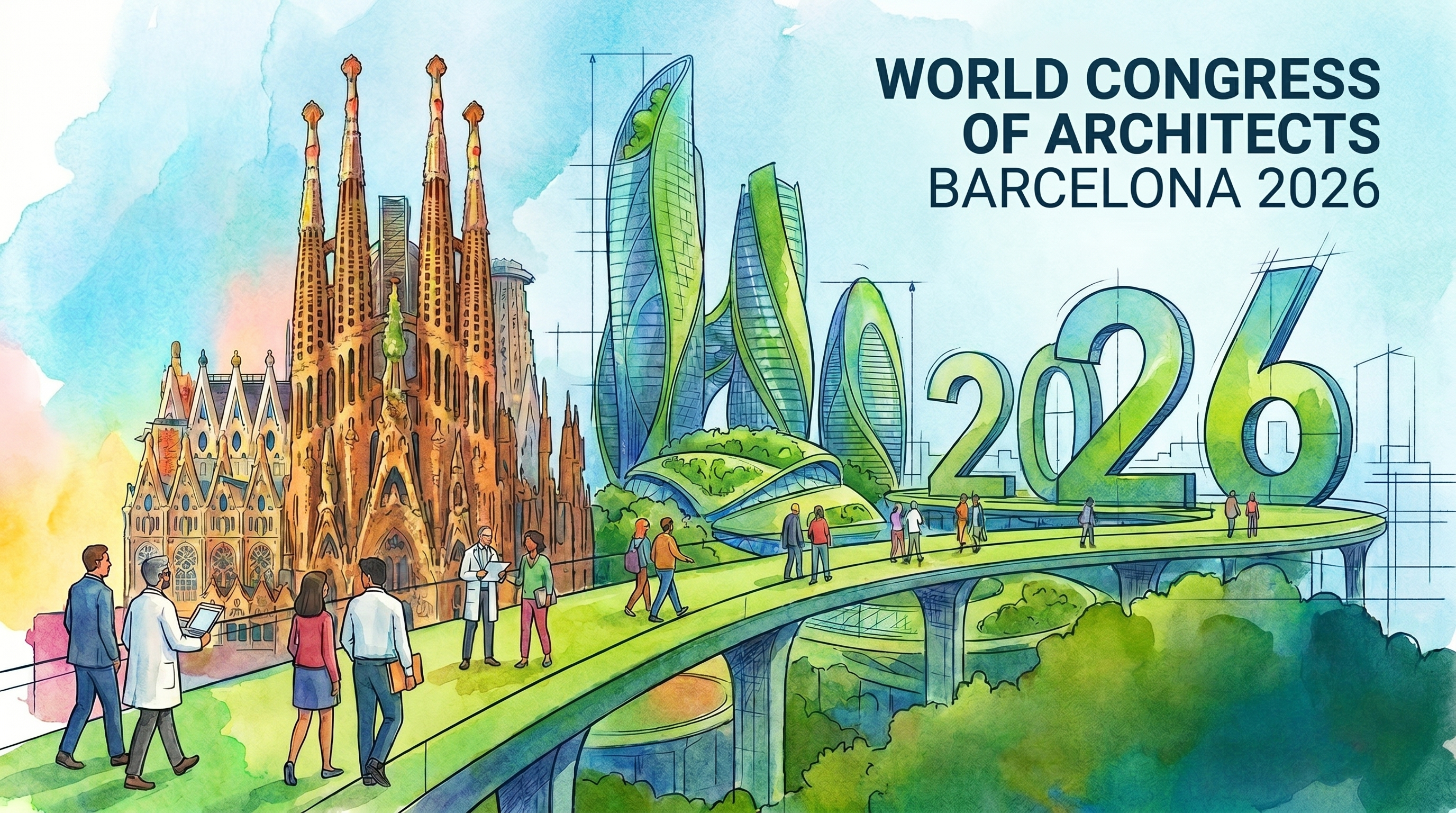
July 2026 | CCIB – Centre de Convencions Internacional de Barcelona, Parc del Fòrum
Verify exact dates at uia-architectes.org — the congress typically runs 5–6 days.
No city on earth is better suited to host a world congress of architects than Barcelona. Gaudí's masterworks are distributed across the city like a permanent open-air exhibition. The Eixample is itself a 19th-century urban planning experiment still functioning at scale. And 2026 is the centenary of Gaudí's death — the year the Torre de Jesucristo at the Sagrada Família is consecrated, completing the tallest church ever built. For an architect, a week in Barcelona in 2026 is not just a conference trip. It is a pilgrimage.
Your accommodation should match the occasion. An apartment in the right neighbourhood gives you independence, workspace, and proximity to the architecture — not a hotel breakfast at 7:30 and a lobby full of strangers in lanyards.
Reserve your congress apartment now → Professional stays for UIA delegates — book 90+ days out. Congress week sells out city-wide.
The Union Internationale des Architectes (UIA) World Congress is the largest professional gathering in global architecture — held every three years, rotating between cities. The 2026 edition comes to Barcelona, drawing an estimated 10,000–15,000 architects, urban planners, engineers and designers from over 100 countries.
Congress key details:
| Event | UIA World Congress of Architects 2026 |
| Organiser | Union Internationale des Architectes (UIA) |
| Location | CCIB – Centre de Convencions Internacional de Barcelona |
| Address | Rambla del Prim 1–17, Diagonal Mar |
| Duration | Approximately 5–6 days |
| Expected attendance | 10,000–15,000 delegates |
| Website | uia-architectes.org |
Why Barcelona, why 2026:
The CCIB is located at the Parc del Fòrum, at the far end of Avinguda Diagonal near the sea. Metro Line 4 (yellow) serves it directly.
| Departure point | Metro route | Journey time | Notes |
|---|---|---|---|
| Poblenou / Rambla del Poblenou | L4 to El Maresme-Fòrum | ~8–12 min | Closest residential area |
| Barceloneta | L4 to El Maresme-Fòrum | ~10 min | Seafront walk alternative (30 min) |
| Jaume I (El Born) | L4 to El Maresme-Fòrum | ~12 min | — |
| Verdaguer (Eixample) | L4 via Girona/Clot | ~20 min | Transfer at Clot or Passeig de Gràcia |
| Passeig de Gràcia | L2/L4 via Girona or direct | ~18 min | — |
| Gràcia (Fontana) | L3 to Diagonal → L4 | ~25 min | — |
| Sants | L1 to Clot → L4 | ~28–30 min | From high-speed rail hub |
Walking note: From any Poblenou apartment, the CCIB is a pleasant 15–20 min walk along the seafront promenade — viable for morning sessions before the July heat builds.
Taxi / Rideshare: Available but slow during peak morning registration (08:30–09:30). Metro is faster and more reliable.
A five-day professional congress creates different accommodation needs from a music festival. The case for apartments is, if anything, stronger.
What delegates actually need:
Check delegate availability → Weekly rates available — stays of 5–7 nights for full congress programme.
For a delegate attending the world congress of architects in Barcelona, staying in the Eixample is the only decision that requires no justification. The neighbourhood is Gaudí's living laboratory: Casa Batlló, Casa Milà (La Pedrera) and Casa Calvet are within walking distance of each other. Domènech i Montaner's Hospital de Sant Pau — a UNESCO World Heritage modernista complex — is a 10-minute walk. And the Cerdà grid itself, designed in 1859 as an equalitarian urban expansion model with chamfered corners to allow light and airflow, is the street beneath your feet every morning.
Transit to the CCIB takes 18–22 minutes via L4 from Verdaguer or Passeig de Gràcia — a reasonable congress commute.
If minimising commute time is the priority — early sessions, multiple daily trips, working lunches back at the apartment — Poblenou is the practical choice. The neighbourhood is 10 minutes from the CCIB on foot or 8 minutes on L4, and it has its own architectural narrative: the 22@ innovation district repurposed a 19th-century industrial zone into a contemporary workplace cluster with notable buildings by Ábalos+Herreros, Benedetta Tagliabue (EMBT) and others.
See Poblenou apartments → Closest residential area to CCIB — ideal for multi-day delegates with full programmes.
El Born places delegates within the medieval city — the Barri Gòtic and El Born are a 10-minute walk apart, and together they constitute the best surviving medieval urban fabric in Spain. The Mercat de Santa Caterina (EMBT, Benedetta Tagliabue — rooftop mosaic; 2005) is 5 minutes from most El Born apartments. The Palau de la Música Catalana (Domènech i Montaner; UNESCO) is 10 minutes. For delegates combining congress sessions with architectural study, El Born is the most culturally loaded base in the city.
Transit to CCIB via L4 from Jaume I is 12 minutes direct.
Gràcia is the neighbourhood that looks most like Barcelona actually lives: village-scale streets, plaças with terraces, a local market, and almost no tourist infrastructure. Transit to the CCIB is 25 minutes (L3 to Diagonal, then L4), which is a real commute — worth it for delegates who want to spend evenings in a neighbourhood that functions as a city rather than as a hospitality zone. Casa Vicens (Gaudí's first major work; newly opened to the public) is in Gràcia.
The UIA Congress week sits inside a remarkable Barcelona architectural moment. For delegates who can extend their stay:
| Date | Event | Architectural relevance |
|---|---|---|
| Jun 10, 2026 | Torre de Jesucristo consecration, Sagrada Família | Gaudí centenary — world's tallest church completed |
| Jun 14 | Gaudí Centenary Mass | Cathedral + international pilgrimage |
| Jun 27 | Gaudí death centenary (100 years) | City-wide commemorations |
| Jul (TBC) | UIA World Congress of Architects | Main congress programme, CCIB |
| Year-round | Gaudí centenary exhibitions | MNAC, Fundació Tàpies, CCCB |
| Year-round | Park Güell, Casa Batlló, La Pedrera | Open to congress delegates |
A delegate arriving a week before the congress to see the Sagrada Família consecration, then attending the full congress programme, has a 10–12 day itinerary that is coherent from start to finish — and justifies an apartment on economics and comfort alike.
Day 1 (arrival/evening): Walk the Passeig de Gràcia — Casa Batlló, Casa Amatller, Casa Lleó Morera (the Block of Discord). Dinner in Eixample.
Day 2 (morning before congress): La Pedrera rooftop at opening time (09:00) — book ahead. Wander the Cerdà grid; note how chamfered corners work at street level.
Day 3 (congress free evening): Palau de la Música Catalana — evening concert, guided interior visit. El Born neighbourhood for dinner.
Day 4 (congress free half-day): Hospital de Sant Pau (Domènech i Montaner). UNESCO complex, fully open, far less crowded than Gaudí sites.
Day 5 (weekend): Sagrada Família full visit — book online, first slot. Park Güell (timed entry required). Afternoon: Parc de la Ciutadella (Fontseré / young Gaudí iron gate).
Day 6 (weekend): Mercat de Santa Caterina roof (EMBT). Poblenou 22@ district walk. CCIB architecture (Herzog & de Meuron Forum building, visible from the seafront).
Registration and access:
Getting around:
Connectivity:
Extending your stay:
Q: Where exactly is the CCIB? The Centre de Convencions Internacional de Barcelona is at Rambla del Prim 1–17, in the Diagonal Mar area adjacent to Parc del Fòrum. Metro L4, El Maresme-Fòrum station — 5 minutes on foot from the exit.
Q: Is the CCIB the right venue or is it at Fira Gran Via? The CCIB at Parc del Fòrum is the primary convention centre for international congresses of this scale. Verify on uia-architectes.org — satellite events may also use Fira Gran Via (L'Hospitalet) or the Palau de Congressos de Catalunya (Diagonal/Pedralbes).
Q: How far in advance should I book an apartment? For a congress of 10,000–15,000 delegates, Barcelona hotel and apartment inventory for the congress week will be under significant pressure. Book 90–120 days out minimum. Eixample and Poblenou stock goes first.
Q: Is Barcelona safe for solo professional travellers? Yes. Barcelona is consistently ranked among the safest major European cities for professional travel. Standard urban precautions apply (pickpocketing in tourist areas); the congress neighbourhood around Fòrum and the Eixample are low-risk.
Q: Can I combine the congress with the Sagrada Família inauguration (June 10)? Only if the congress dates extend into late June or if you build in pre-congress days. The Torre de Jesucristo consecration is June 10, 2026. If the congress runs in July, plan a week's arrival gap and book the Sagrada Família separately — it will be one of the most visited events of the year.
Q: Do Barcelona apartments have reliable WiFi for remote working? Most apartments at lodgingapartments.com include high-speed fibre broadband. Confirm with the host if upload speed matters for video presentations or remote sessions.
An architect arriving in Barcelona for the UIA World Congress in 2026 has a rare opportunity: the professional and the personal are the same trip. The conference is the city. The city is the conference.
Stay somewhere that matches that. An apartment in the Eixample or Poblenou gives you the independence to work late, walk to a Gaudí building before breakfast, and host a working dinner without booking a hotel restaurant. For a five-day congress, the economics make it easy. The experience makes it obvious.
Book now — congress week fills months in advance:
See all available apartments for UIA Congress week →
 Cookies consent


